When Hawthorne homeowners call Best Hawthorne Attic Insulation for an attic upgrade, one of the most common questions we hear is: "Should I go with blown-in insulation or spray foam?" Both are excellent products, but they serve different purposes and perform best in different situations. Here's a straightforward comparison to help you decide.
What Is Blown-In Insulation?
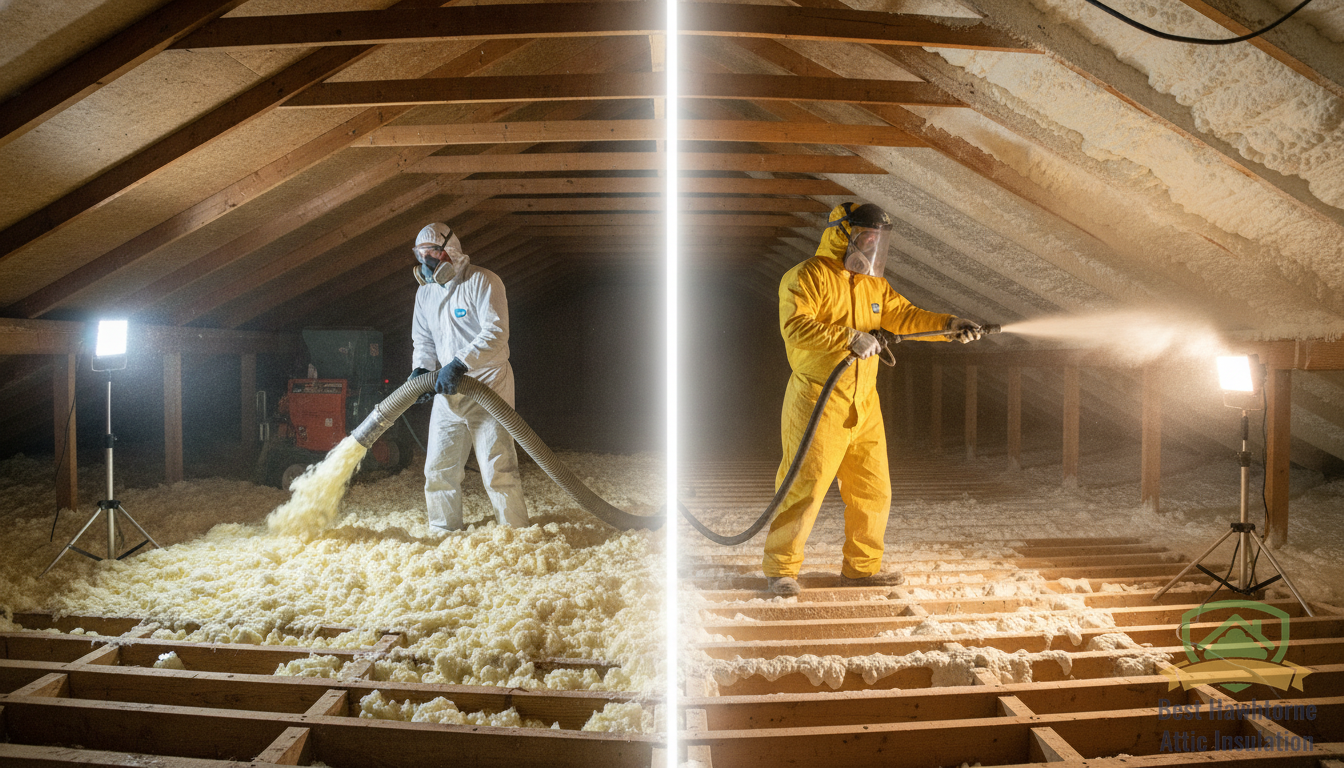
Blown-in insulation — also called loose-fill insulation — is made from either fiberglass or cellulose (recycled paper fiber) and is installed using professional blowing machines that distribute the material evenly across an attic floor. It fills irregular bays, works around existing obstructions like pipes and wiring, and can be installed over existing partial insulation without requiring a full tear-out. Our blown-in insulation service is one of the most popular upgrades we perform for Hawthorne homeowners because of its combination of performance, speed, and cost-effectiveness.
What Is Spray Foam Insulation?
Spray polyurethane foam (SPF) is applied as a liquid that expands on contact with a surface, creating a seamless, rigid thermal barrier that simultaneously insulates and air seals. It comes in two forms: open-cell foam (lower cost, more vapor-permeable, good for interior applications) and closed-cell foam (higher R-value per inch, vapor barrier properties, ideal for moisture-sensitive areas). Our spray foam insulation service is a premium option for homeowners who want maximum performance in specific high-priority areas.
R-Value and Thermal Performance
For standard attic floor applications in Hawthorne, blown-in cellulose or fiberglass installed to the recommended depth of R-38 to R-60 delivers excellent thermal resistance at a very competitive cost. Closed-cell spray foam achieves approximately R-6.5 per inch, which means it can hit high R-values in thinner profiles — making it invaluable in tight spaces like rim joists, cathedral ceilings, or unvented attic assemblies where depth is limited. For a typical vented attic floor, blown-in is usually the more economical path to the same R-value target.
Air Sealing Capability
This is where spray foam has a significant edge: it simultaneously insulates and air seals in a single application, eliminating bypasses around penetrations as it expands. Blown-in insulation, by contrast, does not stop air movement on its own — it must be paired with a dedicated air sealing step first. That's why we always perform attic air sealing before installing blown-in insulation, using expanding spray foam and caulk to close gaps around recessed lights, plumbing vents, and top plates before any loose-fill material is added. When this two-step process is followed correctly, the energy performance rivals a full spray foam installation at a lower total cost for most Hawthorne attics.
Cost Comparison
Blown-in insulation is generally more affordable per square foot than spray foam, making it the practical choice for large attic floor areas. Closed-cell spray foam can cost three to five times more per square foot, which is justified in specific applications but adds up quickly in a full attic. Many of our Hawthorne customers choose a hybrid approach: blown-in insulation for the attic floor combined with spray foam on rim joists, attic hatches, or other problem areas where a seamless seal is critical.
Best Applications for Each Product
- Blown-in insulation: Vented attics with standard framing, top-ups over existing insulation, large square footage areas, homes with budget constraints, and attics in Lawndale, Inglewood, and Alondra Park where cost efficiency matters.
- Spray foam insulation: Unvented attic assemblies, cathedral or vaulted ceilings, rim joists and crawl space walls, areas with moisture concerns, and applications where both high R-value and vapor control are needed in a thin profile.
Don't Forget Radiant Heat
In Hawthorne's sunny Southern California climate, both blown-in and spray foam insulation work even better when paired with a radiant barrier installation on the underside of your roof rafters. Radiant barriers block solar heat before it can warm your insulation and living spaces, reducing attic temperatures by as much as 20–30°F in peak summer conditions.
Get a Free Attic Assessment
Still not sure which option is right for your home? Best Hawthorne Attic Insulation offers free attic inspections throughout Hawthorne, Westmont, Lennox, and the surrounding South Bay area. Our team will assess your attic's current conditions, recommend the best insulation strategy, and provide a detailed written estimate. Call us at (310) 982-2205 or visit our contact page to schedule your visit today.
Need Service?
Call +13109822205 or fill out our online form for a free, no-obligation quote.
Request Free Quote